Growing Beyond the RBT Role: Is BCBA the Only Option?

In the world of Applied Behavior Analysis (ABA), RBTs are the lifeblood of quality care.
Registered Behavior Technicians are the professionals on the front lines — building rapport, teaching communication skills, collecting critical data, and helping clients make meaningful progress every single day. They are the ones turning treatment plans into real-world change.
Without RBTs, ABA simply doesn’t work.
But as impactful as this role is, many RBTs eventually begin to ask: Is becoming a BCBA the only way to grow in this field?
The answer might surprise you.
What Is an RBT?
Let’s start with the basics.
RBTs provide direct, 1:1 behavior-analytic services under the supervision of a BCBA (Board Certified Behavior Analyst) or BCaBA.
Most commonly, RBTs work with individuals diagnosed with Autism Spectrum Disorder (ASD), delivering medically necessary, evidence-based ABA (Applied Behavior Analysis) services. However, ABA principles can be applied across many populations and settings.
Where Do RBTs Work?
RBTs can provide services in:
Clients’ homes
Clinics
Schools
Community settings
RBTs are truly the backbone of ABA therapy. They:
Implement behavior intervention plans
Collect and record data
Teach communication, social, and daily living skills
Help reduce challenging behaviors
Make therapy engaging and fun
They are hands-on, impactful, and essential members of the care team.
How Do You Become an RBT?
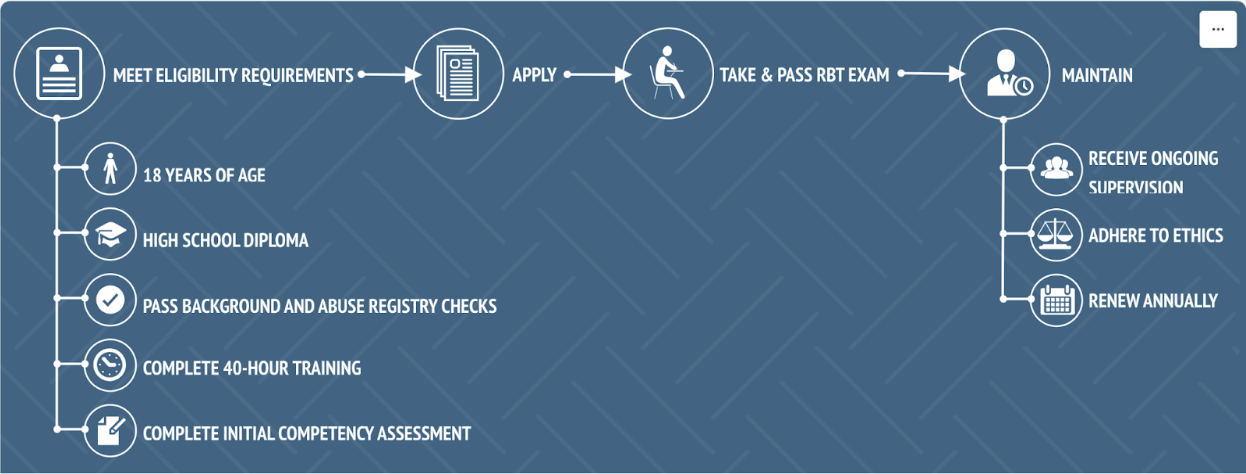
Becoming an RBT involves several specific steps established by the BACB. Here’s what is currently required:
Step 1: Meet Basic Eligibility Requirements
You must:
Be 18 years or older
Have a high school diploma or equivalent
Pass a criminal background check
Step 2: Complete a 40-Hour Training
You must complete a 40-hour RBT training program that meets BACB requirements.
Pro Tip: Not all 40-hour trainings are created equal. Look for programs that:
Follow the official RBT Task List
Offer instructor support
Have strong exam pass rates
Provide clear preparation for the competency assessment
You can verify program requirements directly through the Behavior Analyst Certification Board website BACB.
Step 3: Pass the RBT Competency Assessment
After completing the training, you must pass a competency assessment.
This assessment:
Is conducted by a qualified BCBA or BCaBA
Can be completed in person (and in some cases via approved telehealth formats)
Covers all areas of the RBT Task List
Includes both knowledge and demonstration of skills
You cannot apply for the exam without this completed assessment.
Step 4: Apply to the BACB
Create an account with the Behavior Analyst Certification Board and submit your application.
You must include:
Proof of 40-hour training completion
Completed competency assessment documentation
Background check verification
Application fee: $45
Step 5: Pass the RBT Exam
Once your application is approved, you can schedule your exam.
Exam details:
85 multiple-choice questions (75 scored, 10 unscored pilot questions)
90-minute time limit
Administered at a Pearson VUE testing center
Exam fee: $60
After passing, congratulations — you are officially an RBT!
RBT — Now What?
Becoming an RBT opens many doors. But growth doesn’t stop at certification.
When applying to positions, ask potential employers:
Are there RBT level systems?
Is there mentorship?
Are there leadership opportunities?
Is supervision structured and supportive?
Many companies offer ways to “level up” without immediately pursuing graduate school.
Advancement Opportunities Within the RBT Role
Depending on the organization, experienced RBTs may:
Work with more complex clinical cases
Become RBT Trainers and support onboarding staff
Assist BCBAs with materials preparation
Support assessments and skill probes
Mentor newer technicians
Take on lead RBT or senior RBT roles
Growth doesn’t always mean changing certifications — sometimes it means expanding responsibility and expertise.
Love the Clinical Side? Consider Becoming a BCaBA or BCBA
If you enjoy the clinical components but aren’t ready for a master’s degree, the BCaBA could be a strong next step.
The Board Certified Assistant Behavior Analyst (BCaBA) is also credentialed by the Behavior Analyst Certification Board.
BCaBA Requirements
Bachelor’s degree
Completion of verified coursework in behavior analysis
Supervised fieldwork hours
Passing the BCaBA certification exam
What Can a BCaBA Do?
Under BCBA supervision, BCaBAs can:
Conduct assessments
Assist with treatment planning
Analyze data
Supervise RBTs
Train staff
This role allows for increased responsibility while still working within a supervised structure.
What About Becoming a BCBA?
The BCBA requires:
A master’s degree
Verified ABA coursework
Supervised fieldwork
Passing the BCBA certification exam
BCBAs can:
Conduct functional behavior assessments
Design and oversee treatment plans
Supervise RBTs and BCaBAs
Make clinical decisions independently
It’s a fantastic path — but it’s not the only path!
Want to Explore Non-Clinical Growth?
Here’s where many RBTs are pleasantly surprised. Your skills transfer well beyond direct therapy.
Organizational & Administrative Paths
Many ABA companies value experienced RBTs for roles such as:
Operations Coordinator
Scheduling Manager
Clinical Administrator
RBT Recruiter
Training Coordinator
Intake Specialist
Why? Because you understand:
Documentation requirements
Reinforcement systems
Data tracking
Client needs
Staff challenges
That insight is incredibly valuable in leadership and operational roles.
Healthcare Administration
With additional education or experience, RBTs may pursue:
Patient Care Coordinator
Clinical Scheduler
Healthcare Administrator (degree required)
Quality Assurance Specialist
Your experience with compliance and documentation gives you a strong foundation.
So… Is BCBA the Only Option?
Absolutely not.
You can:
Deepen your clinical expertise
Move into leadership
Transition into operations
Explore healthcare administration
Become a BCaBA
Or pursue BCBA when (and if) the time is right
The RBT credential is not a dead end — it’s a launch point.
The key is asking: What kind of work energizes me? Direct care? Leadership? Systems? Teaching?
Whether you're newly certified or an experienced RBT thinking about your next step, your work matters — and your growth matters too. If you're looking for a supportive team that values your impact and invests in your development, we invite you to explore our current RBT openings and apply today.