Sustainable ABA Starts With Better Leadership, Not Bigger Caseloads
Growth in ABA is often measured in numbers: more clients, more locations, more RBTs, more billable hours, and more referrals.
But sustainable growth requires organizations to pay attention to something harder to quantify: whether the people responsible for delivering care actually have the systems, support, and capacity to do their jobs well.
For BCBAs, that means sustainable ABA cannot simply be a question of how many clients can technically fit onto a caseload. Organizations also have to account for supervision, treatment planning, research, parent communication, documentation, staff development, unexpected challenges, and the countless other responsibilities that exist outside of a billable appointment.
Building stronger ABA organizations starts by changing the way we think about leadership, capacity, and community.
A Full Caseload Isn't Necessarily a Sustainable Caseload
A spreadsheet can tell you that a BCBA has enough hours available to take another client. That doesn't necessarily mean they have the capacity to serve that client well.
Caseload planning has to consider the work happening between appointments. Every case requires clinical decision-making, preparation, analysis, collaboration, documentation, staff supervision, caregiver communication, and problem-solving. Newer BCBAs may also require additional time to research interventions, seek mentorship, and develop their clinical judgment.
When organizations build caseloads around billable hours alone, that invisible work doesn't disappear. Instead, it may get pushed into evenings and weekends, compressed into already busy schedules, or delayed as clinicians try to prioritize competing responsibilities.
Over time, an unsustainable workload can contribute to burnout, turnover, inadequate supervision, and inconsistent support for both staff and families.
Sustainable ABA requires organizations to plan for the entire job, not just the hours they can bill.
Good Leaders Don't Need to Have Every Answer
BCBAs are trained to solve problems. That strength can become a leadership weakness when clinicians feel like becoming a supervisor means suddenly needing to know everything.
A parent asks a question. An RBT encounters a new behavior. A staff member needs guidance. A problem appears during a meeting. The pressure to immediately produce an answer can be enormous.
But good clinical leadership doesn't mean responding the fastest. Sometimes the most responsible response is simply, “I need to think about that.”
Strong leaders give themselves permission to research, consult others, gather additional information, and return with a thoughtful answer. That behavior also sends an important message to their teams: uncertainty isn't incompetence.
When leaders openly ask questions, they make it safer for everyone else to ask questions too. That psychological safety can be especially important in ABA, where an employee who is afraid of appearing inexperienced may stay silent when they actually need clinical guidance.
Delegation Is Part of Developing Future Leaders
Another common leadership trap is believing that being accountable for the work means personally ensuring everything is done correctly. The intention makes sense. Doing something yourself can feel safer and, sometimes, faster.
But it isn't scalable.
Delegation isn't simply a way to get tasks off a leader's plate. Done well, it becomes a development tool that gives team members an opportunity to practice judgment, gain confidence, and eventually support others.
One useful approach is a progression many clinicians already understand: see one, do one, teach one. A leader can first demonstrate a process and explain the reasoning behind it, then allow the team member to complete it with support available, and eventually ask that person to teach or support someone else.
That final step matters. Teaching can reveal just how much someone already knows and transform an employee who is technically capable but hesitant into a more confident team member.
Leaders also have to leave room for reasonable mistakes. If a supervisor steps in every time someone approaches a problem differently, the employee may learn to wait for instructions instead of developing independent judgment.
The goal isn't to eliminate every possible mistake. It's to build people who can eventually solve problems without you.
Feedback Can't Only Happen When Something Goes Wrong
Clinical environments naturally train people to identify problems. BCBAs spend their days evaluating what needs to change, where implementation is breaking down, what variables may be influencing an outcome, and what needs to be corrected.
That lens is valuable clinically, but it can create a frustrating workplace when leaders apply it to people.
If employees only hear from their supervisor when something needs to change, silence becomes the closest thing they receive to praise. Leaders should therefore be equally intentional about recognizing what is working.
Recognition doesn't require an elaborate employee rewards program. Leaders can build it into everyday operations by:
Calling out strong work during team meetings or in internal communication channels
Recognizing employees who develop useful solutions or resources
Celebrating professional milestones and achievements
Giving employees an opportunity to present or explain something they created
Providing specific positive feedback instead of assuming someone already knows they're doing well
If you're already thinking, “That was good work,” say it.
Recognition is information too.
ABA Doesn't Have to Operate From a Scarcity Mindset
The complexity of ABA makes community one of the field's greatest potential resources.
One BCBA may understand a payer better. Another may have experience navigating a particular clinical challenge. Someone else may have built an effective process for supervision, onboarding, documentation, caregiver training, or practice operations.
Treating all of that knowledge as proprietary leaves clinicians solving many of the same problems independently.
A stronger approach is to treat the field more like a collective knowledge network. BCBAs can ask one another questions, share useful resources, discuss both successful and unsuccessful approaches, build relationships with peers outside their organizations, and create opportunities for mentorship and collaboration.
Most importantly, another BCBA's success does not inherently diminish your own.
In a field where families can struggle to access services and organizations can struggle to recruit and retain clinicians, stronger practitioners and stronger practices can increase the field's collective capacity to serve.
Community doesn't eliminate competition entirely, especially for organizations operating within the same market. But it does challenge the assumption that knowledge, mentorship, and professional support need to be guarded in order for one organization to succeed.
Organizational Health Shows Up in the Questions Leaders Are Willing to Answer
BCBAs evaluating a new job shouldn't only ask about salary.
Operational questions can reveal much more about what working inside the organization will actually feel like. Before accepting a position, clinicians may want to ask:
How are BCBA caseloads determined?
How is indirect clinical work accounted for?
What happens when a clinician says their caseload is no longer manageable?
What supervision and mentorship are available to newer BCBAs?
What does discharge planning look like?
How does the organization handle RBT callouts or staffing gaps?
How are performance expectations and billable requirements determined?
What restrictions or contractual obligations apply if an employee eventually leaves?
The individual answers matter, but so does the organization's willingness to answer them clearly.
If basic questions about workload, support, clinical expectations, or operations are difficult to answer during the interview process, that information itself may help a BCBA determine what additional questions they need to ask before accepting the role.
Technology Should Reduce Complexity, Not Create More of It
The same principle applies to the technology ABA organizations rely on.
Practice management software can touch nearly every part of an organization's operations, including scheduling, billing, authorizations, payroll, documentation, intake, data collection, reporting, and more.
A polished demo isn't enough. Organizations should ask vendors to demonstrate how their software actually performs the tasks their teams complete every day.
Rather than only asking whether a platform has a particular feature, dig into how that feature works in practice. Ask the vendor to show it live. Find out how different tools connect with billing and other workflows, what happens as the organization grows, how customizable the system is, and who is responsible for helping when something goes wrong.
One of the most important questions may have nothing to do with the demo itself: What happens six months from now when we need help?
Implementation support is valuable, but organizations also need to understand what ongoing customer service looks like once they're fully operating inside the platform.
It is also worth asking who influences product development. Software built for clinicians should continue listening to clinicians after launch.
Technology should ultimately remove unnecessary administrative friction so BCBAs can spend more of their energy on the work that requires their expertise.
Sustainable ABA Is Built Through Systems
Sustainability isn't created by asking clinicians to work harder inside broken systems. It's created by improving the systems themselves.
That means building realistic caseloads, developing leaders who know how to delegate, creating teams where questions are welcomed, recognizing people when they're doing excellent work, choosing technology that reduces administrative burden, and building professional communities where clinicians can learn from one another.
For BCBAs interested in building their own practices, these lessons become even more important. Ownership isn't simply an opportunity to recreate existing organizations on a smaller scale. It's an opportunity to rethink how those organizations operate.
BCBAs already understand behavior, systems, environments, and how those environments influence outcomes. Those same skills can be applied to building organizations where clinicians, staff, and families are better supported.
Because building a better ABA practice isn't only about how much you can grow. It's about creating something that can continue working well when you do.
Continue the Conversation
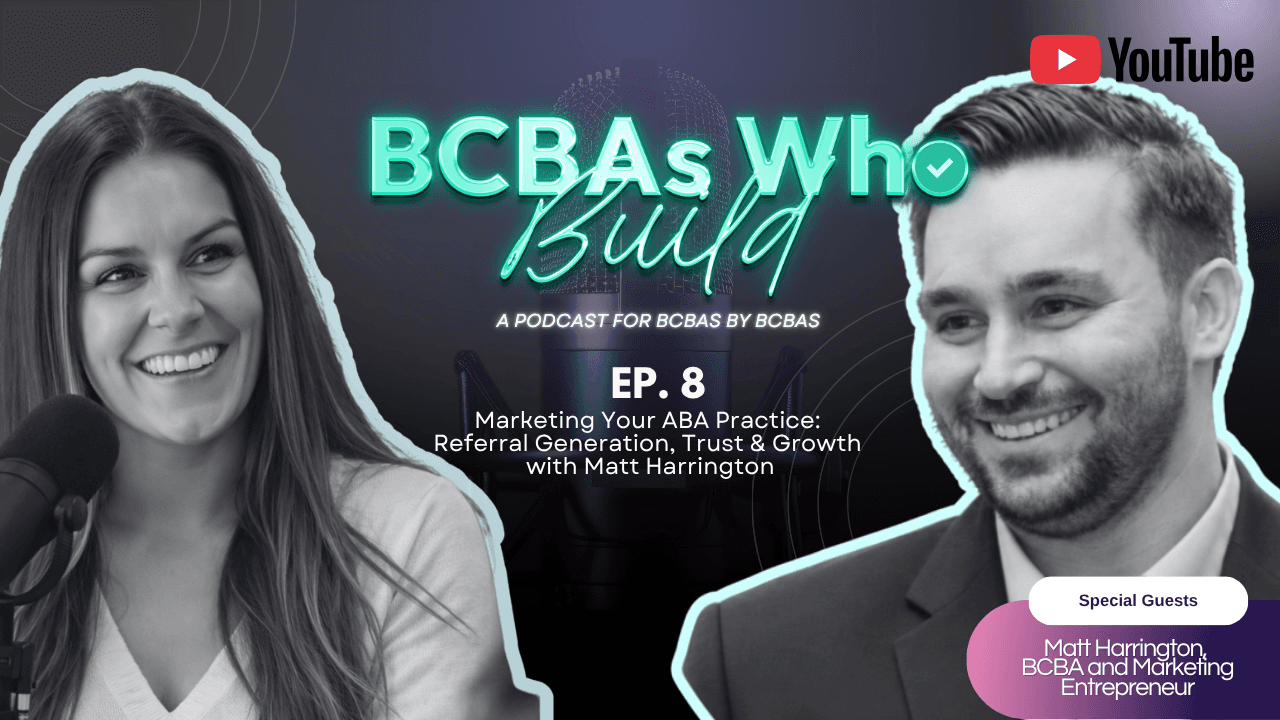
These ideas were inspired by a conversation between Dr. Sara Feldman and Megan Shauna Jones, BCBA and Director of Customer Success at AlohaABA, on BCBAs Who Build. Their full conversation dives deeper into BCBA leadership, burnout, organizational red flags, caseload management, community, ABA technology, and what sustainable growth can look like in practice.
Watch the full episode on YouTube or visit headstart.health/podcasts to listen to this and more episodes of BCBAs Who Build.
Simplify the Business Side of ABA with AlohaABA
Building and growing an ABA practice means managing a lot more than clinical care. From scheduling and authorizations to billing, payroll, data collection, and reporting, the right systems can make a major difference in how efficiently a practice operates.
AlohaABA is a cloud-based practice management and electronic medical records (EMR) platform built specifically for ABA therapy providers and autism clinics. By bringing clinical and administrative workflows together in one centralized system, AlohaABA helps providers spend less time managing disconnected processes and more time focused on their teams, clients, and quality of care.
With tools for scheduling, billing and invoicing, authorization management, payroll integration, clinical data collection, and operational analytics, AlohaABA is designed to support ABA practices as they grow.
Want to learn more about AlohaABA and how it can support your practice? Visit AlohaABA.com.