More Than Representation: Building Community, Supporting RBTs, and Changing the ABA Field
Applied behavior analysis is grounded in science, but the profession is also shaped by something more human: who feels welcomed, whose expertise is elevated, and whether the people closest to the work feel supported.
Representation can help people enter the room. Community helps them stay, lead, and create meaningful change.
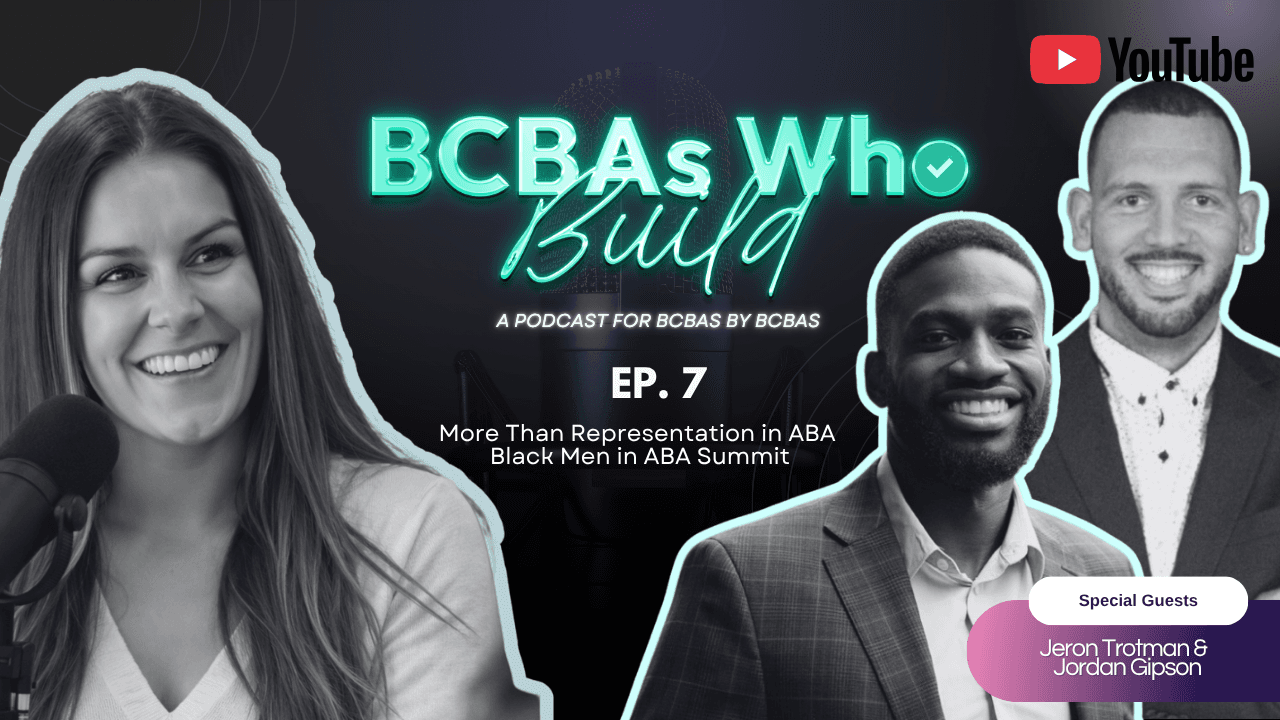
In this episode of the BCBAs Who Build Podcast, Dr. Sara Feldman sat down with Jeron Trotman and Jordan Gipson to explore community, representation, leadership, and the future of ABA. They discussed why diverse professional spaces matter to families, why RBTs need stronger support and connection, and how the Black Men in ABA Summit is designed to move the field beyond visibility and toward impact.
Below is an edited version of their conversation, lightly condensed for length and clarity while preserving the guests' original meaning and language.
Podcast Details
Podcast: BCBAs Who Build
Host: Dr. Sara Feldman, Ph.D., BCBA
Guests: Jeron Trotman and Jordan Gipson
Featured topics: Representation, RBT support, community building, leadership, and the Black Men in ABA Summit
Why Does Representation Matter in ABA?
Sara: What does representation help and serve for the families we're supporting, and what does it mean to move beyond that?
Jordan: I'm in Southern California, so it's a very diverse area. When a family of color sees somebody of color coming in for an assessment, you can visibly see a level of relaxation. Their shoulders drop a little bit. It's like, 'I can actually communicate about the real stuff.'
There's a transparency that comes with that. They may feel that you understand how someone might look at them, the extra things they sometimes have to do, or why certain parts of their culture are important. They don't have to explain all of it in as much depth.
Jeron: Representation and inclusivity should be parts of our foundation. Diversity is important, but we also have to ask how it shows up in research, ethics, entrepreneurship, leadership, professional growth, mentorship, supervision, and innovation.
Who are we platforming, and why? Are we platforming enough people who are representative of the people we serve? Representation, diversity, and inclusion strengthen the quality of care and the relevance of our field. We have made progress, but we still have a long way to go.
What Does It Mean to Move Beyond Representation?
Sara: The theme of the Black Men in ABA Summit is 'More Than Representation.' What does that mean to you?
Jeron: Representation is very important, but it goes beyond that. What are we doing once we're in the room? How are we carrying ourselves? How are we collaborating, making an impact, and influencing people?
It isn't just about seeing what we look like. It's about seeing what we bring to the field, who is in the room, what conversations we're having, and how we track and measure our impact. We're moving to the next level. It isn't just the representation part anymore. Now let's get into the room and really make change.
Jordan: It shouldn't just be a box to check. We talk about social significance as this major, overarching part of applied behavior analysis, but in some of the communities we serve, we don't socially fit. You can't make decisions about a community without including that community in the decision-making.
There are many minority communities we serve and many people from minority communities trying to enter the field. We need to support them so they can have the same opportunities and provide the same quality of care, if not better, than those who came before them.
What Does the ABA Field Need to Do Differently?
Sara: What do we need to stop doing as a field, and what do we need to do more of if we genuinely want inclusive environments for families and professionals?
Jeron: We can't be afraid to explore the barriers. We're behavior analysts, so what are the conditions or contingencies that keep us from elevating people in certain ways? Why do we enter a space and see twenty people who look exactly the same, without other voices represented?
We also have to look beyond one narrow definition of credibility. Experience matters, and representation matters. If we acknowledge the barriers that can keep someone from a Ph.D., research opportunity, or traditional platform, then years in the field or publication history cannot be the only things we use to decide who is qualified to contribute.
Jordan: You can learn from anybody. If we pigeonhole people into certain requirements, we leave out the business owner in a low-income area who is providing great services but can't afford to pursue a Ph.D. because they would rather give back to their community. That doesn't make their experience any less valid than someone who has written three books.
If we use only one standard, we risk repeating the same conversations and the same work. The field becomes stronger when it makes room for rigorous research, lived experience, community leadership, and practical expertise.
How Can the ABA Field Better Support RBTs?
Sara: You've helped create community not only for BCBAs, but for RBTs as well. What was missing, and what did you want to build?
Jeron: I love talking about the backbone of the field. We can't do anything without behavior technicians. As BCBAs, we have a lot of community. As RBTs, you often don't. There hasn't been a central place for mentorship, supervision, community, and the chance to talk with people going through the same experiences.
An RBT working in a home may see their BCBA once or twice a week, sometimes less, and may not have opportunities to connect with other RBTs. That's why we created the Behavior Technician Association: a professional home where behavior technicians can find mentorship, supervision, professional development, and community.
People also assume every RBT wants to become a BCBA. They don't. Some people love the profession, love direct hands-on work, and want to grow within that role. They deserve a community and a professional home, too.
Jordan: There isn't one fix. Pay matters, but when you sift through it, it isn't only about money. Feeling heard is a major part of the problem. We have to think about workload, the variety of clients an RBT supports, whether they're trained to feel competent and confident, and whether they have a community where they can talk about their experiences.
Communication between levels can also break down. Some BCBAs are clinically strong but struggle to connect with the team doing the work. We have to look in the mirror as a field and be willing to have difficult conversations about what RBTs experience.
Jeron: A BCBA also has to be a coach. Can you get in there and coach, model, and lead? Those skills aren't necessarily on a task list, but when they're missing, things break down. Having conversations like this and putting the problem in the open is a starting point.
What Makes the Black Men in ABA Summit Different?
Sara: For someone who hasn't attended, what should they understand about the Black Men in ABA Summit?
Jeron: The BMBA Summit is our signature annual experience. We're bringing together professionals, students, business owners, behavior technicians, researchers, leaders, and allies from across ABA. There is high-quality professional development, but it is also community-centered, culturally relevant, welcoming, and energizing.
Although BMBA centers the experiences, contributions, and advancement of Black men, the summit is not limited to Black men. It is for the entire behavior analysis community. We want allies in the room who are willing to listen, learn, grow, build relationships with us, and help create a more equitable field.
Jordan: The summit is highly inclusive. A group that knows what it feels like to be excluded understands the importance of making people feel invited. If you come, you're going to leave with friends.
It is also a space where code-switching isn't necessary. People connect as their authentic selves, including speakers, attendees, vendors, and business owners. Taking off the formal business hat creates relationships. The connection is huge, and every part of the programming is built in alignment with that mission.
Jeron: People aren't coming only for CEUs, even though the education is strong. They're coming because we make a deliberate effort to feature voices and perspectives that may not receive visibility at other conferences, and because no other conference in the space approaches networking like this one.
The 2026 Black Men in ABA Summit takes place September 3-6 in Atlanta, with both in-person and virtual participation. Its themes, Bold Voices, Bright Futures and More Than Representation, reflect a larger invitation to move from visibility toward leadership, collaboration, and measurable impact.
What Permission Would You Give ABA Professionals?
Sara: What permission slip would you like listeners to carry back into their ABA careers?
Jeron: You have permission to lead. If you see a problem, jump in and solve it. You don't need anybody's approval, and you don't have to wait for someone to tell you it's time. Create the spaces and opportunities that aren't there yet.
Jordan: I give you permission to be vulnerable. Not just the hard exterior of a behavior analyst, but vulnerable enough to make the connections you need to create meaningful change.
Listen to the Full Episode
This interview has been edited for length and clarity and highlights only a few of the insights Jeron Trotman and Jordan Gipson shared during their conversation with Dr. Sara Feldman.
To hear the full discussion on representation, RBT development, leadership, community building, ABA Versus, and the Black Men in ABA Summit, listen to this episode of the BCBAs Who Build Podcast.
Whether you're an RBT, BCBA, student, business owner, researcher, or ally, this conversation offers a clear challenge: build spaces where people can be seen, supported, and empowered to contribute more than their representation.
Listen now: BCBAs Who Build Podcast