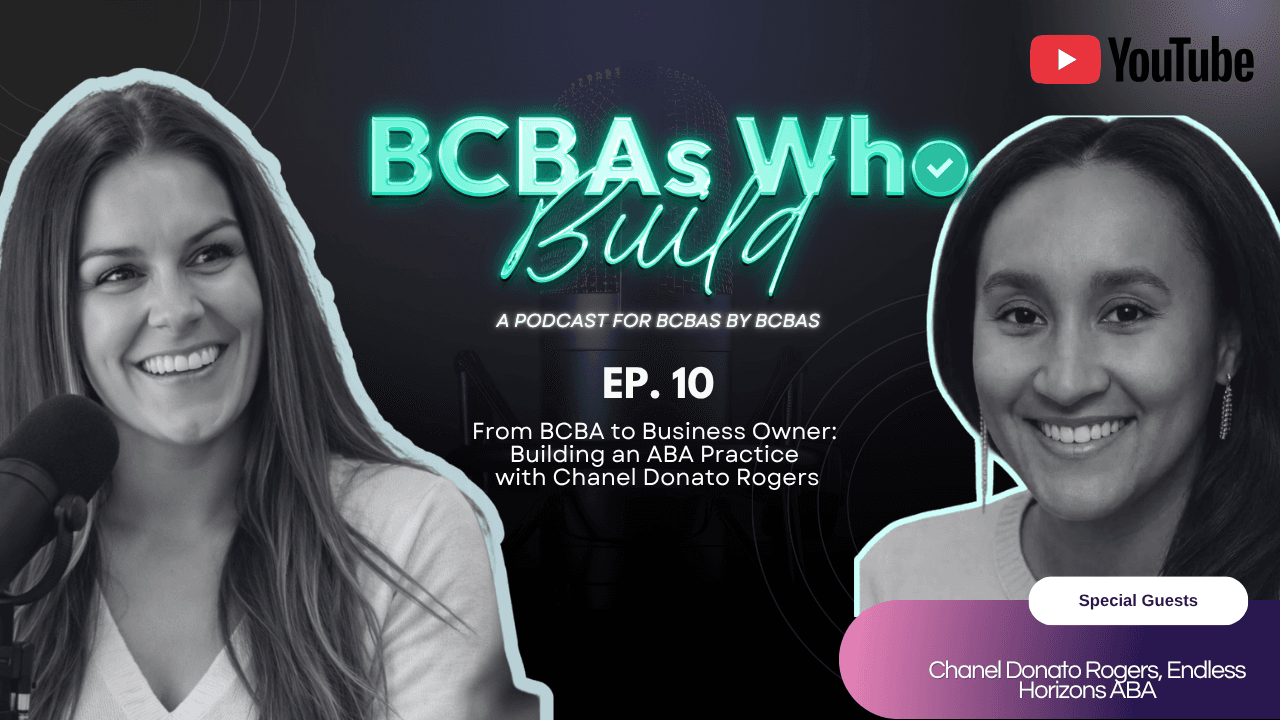
You’re Never Fully Ready: A Conversation with ABA Practice Owner Chanel Donato Rogers
There is rarely a perfect moment to become an entrepreneur.
For Chanel Donato Rogers, BCBA and founder of Endless Horizons LLC, the idea of eventually owning an ABA practice had been growing for years. Each role taught her another piece of the business, from clinical care and treatment planning to authorizations and credentialing.
But knowing how the pieces worked and feeling ready to take ownership of them were two different things. Eventually, circumstances forced Chanel to make a choice: remain comfortable or build something of her own. She chose to build.
Within roughly a year of launching Endless Horizons, Chanel had grown her practice to approximately 30 clients and built a team of BCBAs and RBTs. Along the way, she has learned that entrepreneurship isn't about knowing everything before you begin. It's about creating systems, staying connected to your mission, learning to delegate, supporting your people, and adapting when the plan inevitably changes.
We sat down with Chanel to talk about how she found ABA, what pushed her into entrepreneurship, and what she's learned while building a growing ABA practice.
How did you originally find the ABA field?
Chanel: I literally fell into it by accident.
For undergrad, I went to a small private Catholic college, and we had to do an internship. I picked a local youth center, and my supervisor at the time was actually a BCBA. I was doing intake and data collection.
From there, I started working at a small private school that used ABA principles for children on the spectrum. There was also a day program for young adults and an adult living program, so they really took care of the individual for the longevity of their life.
That's where ABA fell into my lap.
When did owning your own ABA practice first become a goal?
Chanel: When I moved to Georgia, I started another in-home position while I was waiting for the results of my BCBA exam.
In the meantime, I was already learning how to do authorization requests, sitting in on clinical reviews, and doing treatment planning. I was learning a lot of the back end of things in addition to the initial RBT duties and some intake work.
I would say that was a lot of the early groundwork for me. I was learning how to do all of this, and I thought it could definitely be beneficial one day when I wanted to start my own practice.
That was when the seed was planted.
Was there a specific moment when you knew it was finally time to make the leap?
Chanel: The signs were definitely there, but I was also very comfortable.
The thing that made me jump was basically getting a text message one day saying, “Hey, I don't know how I'm going to make payroll.”
I was a new mom, and bills don't stop. I was also thinking about all of the families and staff members who were getting ready to have their world flipped upside down.
That was the moment where comfortability went out the window. You have to do what you have to do at that point, and this was the biggest sign to get going.
What was important to you when you finally had the opportunity to design your own practice?
Chanel: I wanted to make sure I was looking at the full picture. How is this going to affect everyone and not just myself?
Having a healthy business, you can't just have a one-track mind. You have to see everything from multiple perspectives and multiple angles. You have to make sure you're being mindful of everything that's coming in and out while keeping in mind your mission and your why.
What surprised you when you first became an entrepreneur?
Chanel: Some of it came naturally, but I think that was because I had a lot of practice. It wasn't like I was swimming in completely uncharted waters. They were familiar.
I can't say I knew everything, but having open transparency and communication with my staff and families was important. I wanted to make sure they knew what to expect from me and vice versa.
Especially with being in-home, you don't see everybody every day. Sometimes support looks like reaching out with a newsletter or a message saying, “Hey, do you need anything from me? You can always reach me. I'm available, and I will get back to you.”
As an owner, how do you try to catch problems before they grow?
Chanel: I run a lot of reports and double-check that everything is going smoothly. If there is a hiccup anywhere, I want to catch it as early as possible so we can course-correct or put some type of intervention in place if it's needed.
I'm very big on catching anything and everything early when it's possible. I'm constantly reviewing everything.
When did you first have the moment of thinking, “This is actually working”?
Chanel: Probably December of last year.
I signed in July, finished my boot camp around the end of August, and by the beginning of September I already had assessments coming in.
When my first round of clients settled in around December, even though I was still growing, that's when I thought, “Okay, we definitely got this.”
Now we're still going, which is amazing.
Are you able to stop and celebrate what you've built?
Chanel: I should probably congratulate myself a little bit more than I do.
I'm always focused on making sure everything is going how it should be. Sometimes I do have moments where I sit back and look at where I started.
Recently, I hit my client goal, and I was very excited because doing that within a year is huge. Right now, I'm at 30 clients, with a few more trying to trickle in, and I have four BCBAs working alongside me.
Saying that out loud, that's another moment where I have to pat myself on the back and give myself the credit.
What have some of the harder moments of ownership taught you?
Chanel: In the beginning, I had one client where we were trying to get the staffing right. A therapist would be scheduled to start and then no-show, and the family was waiting.
Whenever something like that happens, it feels like a gut punch because I don't ever want a family to feel let down by me.
But no matter how much we plan for something to go perfectly and seamlessly, sometimes it's just not aligning, and it's okay.
If you're truly trying your best, that's all you can do. Sometimes you have to make adjustments, pivot, and collaborate.
As long as you're being open and honest with the families or staff members about what's going on, people tend to digest that better. If you aren't honest, eventually the trust isn't there.
What does supporting RBTs look like at Endless Horizons?
Chanel: It's different for each RBT.
I have some who are like, “If I need you, I'll reach out to you.” I gauge that because I don't ever want anyone to feel micromanaged. I'll give them that space and provide the materials and things they need.
Then I have some who may need to check in with me or their BCBA pretty regularly, and that's okay too.
I go at their pace with what they need from me or the BCBAs. Sometimes it might look like having a phone call once sessions are done for the day because someone needs to bounce ideas off me or wants another perspective.
I'm here. We can sit down and have that conversation and make sure we get it done.
Why has that kind of support been so important to you?
Chanel: Very early on, even when I first became a BCBA, I would always tell everyone, “There's no silly question. There's no question that's too small.”
You could be seeing something I'm not seeing, so anything you want to share, feel free. We're a whole team.
It's not just, “I'm the BCBA, you're the RBT, just implement.”
For the RBTs who want to grow and stay in the field, you have to think about how you're helping shape the next generation of BCBAs. Show them what growth and partnership in BCBA-hood looks like.
It's not, “I have all the answers because I have more experience than you.” That's not necessarily the case.
Everyone can learn from everyone.
Why did you choose to build your practice with Headstart Health?
Chanel: It was honestly the communication and the relationship aspect.
It didn't feel like, “You're going to come in, this is what we offer, just do what we tell you, and this is it.”
I liked that I was going to have the autonomy and you guys would be there for support. I love the relationships with everyone I've met and everyone I interact with every step of the way.
We have our weekly meetings and our mastermind group. It's a full-blown community of support while you're also doing and building your own thing.
The relationships and interactions are what got me.
What's one of the biggest leadership lessons ownership has taught you?
Chanel: I had to learn to delegate because I am the type of person who will just take it on and get it done.
I have this mentality that I'm going to take on any challenge and blast through it like there's nothing I can't do. But sometimes doing all the things will burn you out like a match. Quick.
Learning to delegate is okay, and having a team to help and support you is actually the way to go.
How do you delegate without losing visibility into your business?
Chanel: As an owner, you need to know all of those details.
I may not physically be doing all the little things because we have that teamwork going, but you should still know what's going on.
For me, it's about being intentional. If I want to catch things early, I don't want anything to be a surprise.
What would you tell another BCBA who has the clinical experience and the vision but doesn't know where to start?
Chanel: Don't worry about having all the answers because no matter how long you've been doing this, you never will.
Remember your why and your mission over the course of time because it's going to be bumpy, it's going to be smooth, and sometimes it's going to be straight volatile.
You have to learn to roll with the punches. Don't take anything personally, and it's all going to be okay.
What should a BCBA do first if they're seriously thinking about ownership?
Chanel: Really identify your mission and your values because that's one thing along the way that you don't want to forget.
In your core, ask yourself: Why am I doing this, and who am I doing this for?
Do you ever actually feel ready to become an entrepreneur?
Chanel: Sometimes you're never really going to be fully ready. Sometimes it doesn't happen.
You kind of just have to jump in. Jump in the pool and get in there.
Just go for it. You're never going to feel ready.
What do you give other BCBAs permission to do?
Chanel: You have permission to make mistakes because nothing's going to be perfect.
There's always going to be a moment of, “Ooh, I probably shouldn't have done that,” but that's a learning experience.
If you're not learning, you're not growing.
Be patient with yourself. Everything's going to come together. And breathe.
Hear Chanel's Full Story
Chanel's first year of ownership is about much more than growing a client roster. It's a story about building systems, supporting people, learning to delegate, staying grounded in your mission, and accepting that becoming an entrepreneur doesn't require having every answer before you begin.
Watch Chanel Donato Rogers' full episode of BCBAs Who Build on YouTube or visit headstart.health/podcasts to hear the complete conversation and explore more stories from BCBAs who are building something of their own.