The Future of ABA Is Small Business: Why Clinician-Led Practices Matter
ABA is growing. More families are seeking care, more BCBAs are entering the field, and more organizations are expanding into new markets. While that growth can help increase access to much-needed services, bigger isn't always the only answer.
We believe there is another path forward for ABA: one built around independent, clinician-led practices that are smaller, more intentional, more connected to their communities, and led by the clinicians who understand the work firsthand.
When Clinical Care and Business Decisions Meet
Every ABA organization has to make business decisions. Practices need to hire and support employees, manage expenses, navigate insurance, maintain operations, and generate enough revenue to continue providing services. But ABA isn't just a business. At the center of those decisions are clients, families, RBTs, and clinicians, which makes the people making those decisions incredibly important.
BCBAs bring something unique to practice ownership: firsthand knowledge of what quality care actually requires. They understand the realities of caseloads, supervision, treatment planning, RBT development, family collaboration, and clinical decision-making. When clinicians become owners, they have the opportunity to bring that perspective into the way the entire organization operates.
Rather than adapting their clinical philosophy to fit someone else's company, BCBAs have the opportunity to build a company around their clinical philosophy.
Small Practices Can Be Intentional Practices
Being small doesn't have to mean limiting your impact. Instead, it can mean being more intentional about how and why you grow.
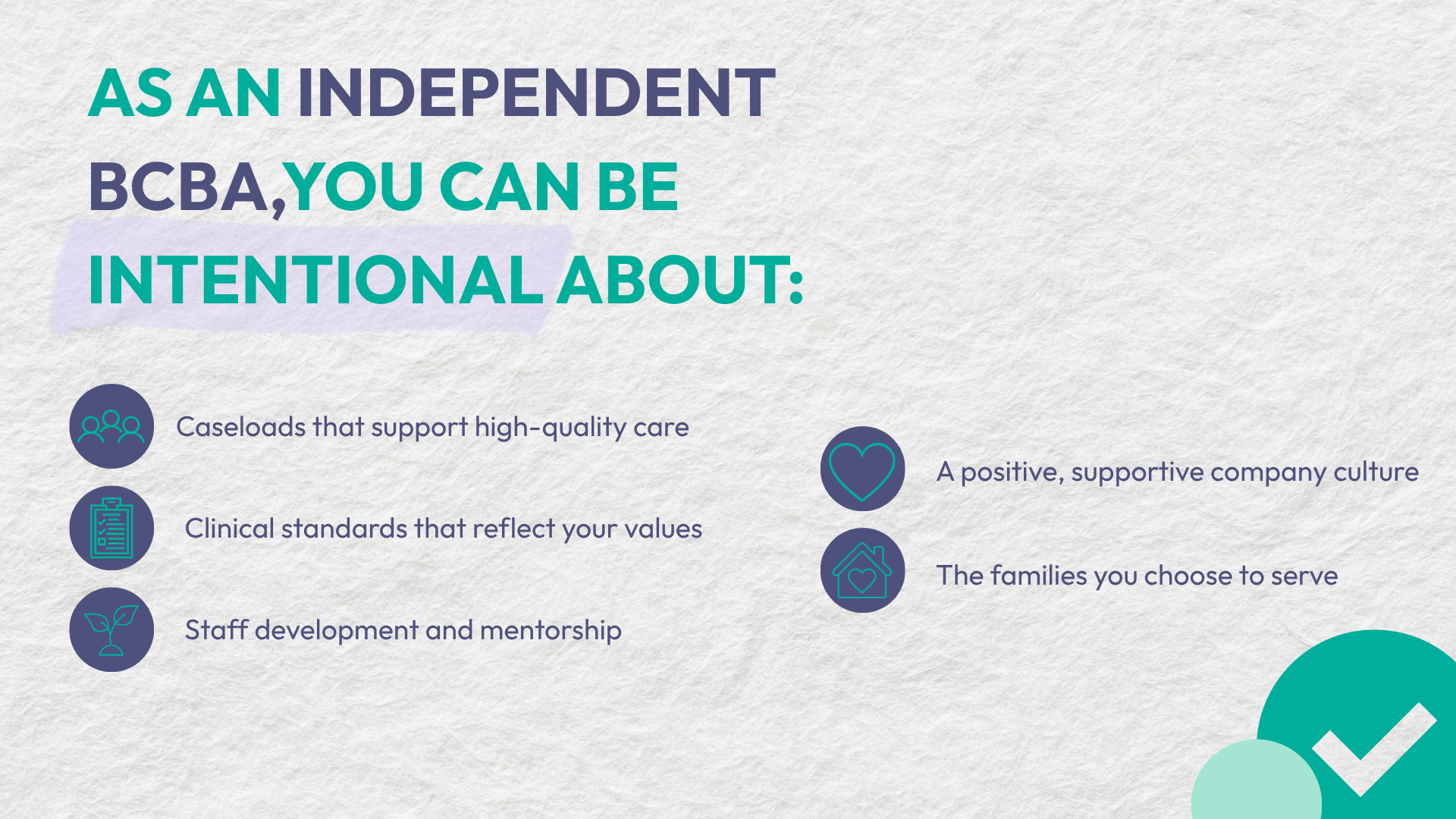
Independent practice owners have the opportunity to make deliberate decisions about the kind of organization they want to build, including how many families they serve, how they support their RBTs, what their company culture looks like, and what standards guide their clinical care.
Growth can still be part of that vision, but growth doesn't have to mean expanding as quickly as possible. It can mean adding a new RBT because another family needs support, hiring another BCBA because your caseload is growing, or expanding into a neighboring community because families there don't have enough options.
Small businesses have the flexibility to grow alongside the communities they serve. For some owners, that could eventually mean building a larger team or expanding into additional communities. For others, staying intentionally small may be exactly what allows them to provide the type of care and workplace culture they envisioned when they started.
Ownership Gives BCBAs More Control Over Their Clinical Environment
Many BCBAs already know what they would want from an ABA practice. They want manageable caseloads, meaningful supervision and mentorship for RBTs, families who feel heard, clinical recommendations driven by client needs, and a workplace culture where clinicians have a voice.
Practice ownership gives BCBAs an opportunity to create that environment themselves. As an owner, you can establish your clinical standards, determine how your team communicates, create systems that support your RBTs, and define what sustainable growth means for your practice.
Ownership comes with significant responsibility, but it also comes with agency. Instead of waiting for someone else to build the kind of ABA company you would want to work for, you have the opportunity to build it yourself.
Local Ownership Creates Local Accountability
Independent ABA practices can also create something that becomes more difficult as organizations scale: deep community connection.
A local BCBA isn't simply entering a new market. They may already live and work there, understand the schools and community organizations around them, and have relationships with families and other healthcare professionals. They can see where gaps in care exist because they are experiencing those gaps alongside the people they serve.
That proximity can create a different kind of accountability. Your reputation is built through the relationships you create with families, RBTs, referral partners, and other members of your community. When your name and your clinical philosophy are closely connected to the practice, the quality of the organization becomes personal.
It also creates an opportunity to make business decisions with a deeper understanding of the community those decisions will affect.
The Goal Isn't More ABA Companies. It's Better ABA Companies.
Simply opening a small business doesn't automatically create better care, and ownership alone doesn't make a practice ethical. What matters is what BCBAs choose to build with that ownership.
The opportunity is to create practices where clinical judgment has a meaningful seat at the table, growth is intentional, employees are supported, families are respected, and quality isn't sacrificed in pursuit of scale.
If more clinicians have the tools and resources to build organizations around those principles, the ABA field has an opportunity to become stronger from the ground up. That change doesn't necessarily require one organization serving every community. It can happen through independent BCBAs building thoughtful, sustainable practices within the communities they already know.
You Know the Clinical Side. You Don't Have to Build the Business Side Alone.
For many BCBAs, the biggest barrier to ownership isn't a lack of vision. It's everything that comes after the idea: setting up a business, navigating credentialing, understanding billing, recruiting RBTs, finding families, managing authorizations, maintaining cash flow, and building operational systems while continuing to be a clinician.
That's where Headstart Health comes in.
Headstart Health helps BCBAs launch and grow independent ABA practices while providing the operational infrastructure and support that can make ownership more accessible. You bring the clinical expertise, the vision, and the understanding of your community. We help you build the business around it.
Because the future of ABA doesn't have to belong only to the biggest organizations. There is room for a future built by independent clinicians who want to provide great care, support their teams, and make a meaningful impact in their own communities.
Ready to build the ABA practice you believe should exist? Learn how Headstart Health helps BCBAs become independent practice owners.